If you have a tattoo and you’re planning a trip that includes a Japanese bath, you’ve probably already run into conflicting answers online—some sources say tattoos are banned outright, others say it’s a non-issue. Neither is quite right. This guide walks through why the rule exists, why it isn’t one single rule, and how to actually plan around it.
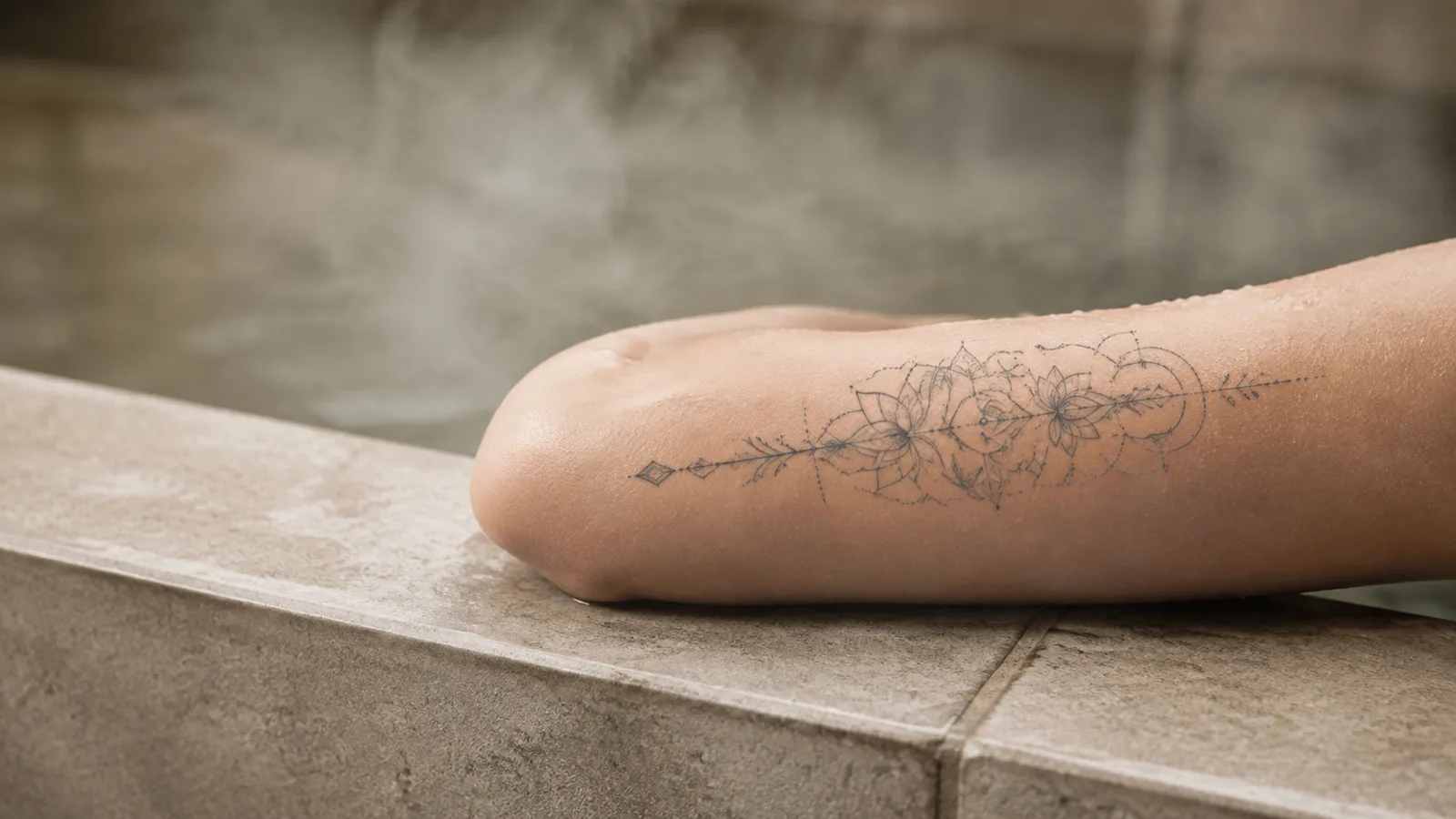
The short answer
Having a tattoo does not automatically shut you out of Japanese bathing culture. It also doesn’t mean every bath will welcome you. Policy is set facility by facility, sometimes region by region, and it genuinely varies—so the honest answer is “it depends,” and this guide is about how to find out where you stand before you arrive at the door.
Why tattoos are sometimes restricted
According to Japan’s official tourism guide, the association between tattoos and criminality in Japan traces back to a time when tattooing was used by authorities as a mark of punishment, and the practice later became linked with organized crime groups. That history is why some bathhouses still post a blanket no-tattoo rule at the entrance, even for a visitor whose tattoo has nothing to do with that history.
It depends on the facility, not the country
There’s no single national law banning tattoos from onsen or sento, and enforcement is, in JNTO’s own words, “very case-by-case.” In practice, facilities tend to land in one of a few places:
- Some maintain a strict no-tattoo policy with no exceptions, regardless of size.
- Some allow a tattoo if it’s fully covered with a waterproof patch or bandage.
- Some place no restriction on tattoos at all.
None of these is the default for “Japan”—each is a policy set by one specific facility, and it can change. A ryokan’s shared bath, a neighborhood sento, and a large super sento in the same city can each take a different position.
Some facilities accept a fully covered tattoo; others don't accept tattoos at all, patch or not. A patch is worth carrying as a backup, not something to count on without checking first.
A simple before-you-go checklist
A little planning avoids an awkward moment at the front desk:
- Check the facility’s own website first. Official policy pages are more current than any blog post, including this one.
- Email or call ahead if it’s unclear. JNTO itself recommends this as the most reliable step, especially for a ryokan you’re already booked to stay at.
- Carry a cover patch as a backup, not a plan. If the facility permits tattoo covers, bring a waterproof patch large enough to conceal the tattoo completely. In Japan, cover products may be available at Don Quijote, larger drugstores, variety stores, or some 100-yen shops, but selection and stock vary by location. Buying one before your trip is safer than relying on finding the right size after you arrive. A cover patch does not override a facility’s no-tattoo policy—always check the facility’s rules first.
- Ask whether a private or reservable bath is available. Some facilities may allow tattooed guests to use a private bath, but this does not override the property’s rules—confirm before booking.
- Or start with a facility that’s already documented as welcoming tattoos, rather than testing an unfamiliar one on arrival.
For a first visit, choosing an experience that is currently described as tattoo-friendly can reduce some of the uncertainty. Check the latest conditions on the booking page before you go.
Want a first visit with one less thing to worry about? This is a guided session at an open-air bath in central Tokyo, near the Skytree, and it’s one of the few that accepts tattoos—the operator states that on the booking page rather than leaving you to ask. Two things to know before you book, so nothing is a surprise at the door: the baths are shared and separated by gender, not private, and don’t count on the large open-air bath if you’re a woman: the listing says that since February 2024, because of chimney work, the large open-air bath has been men-only and the small open-air and carbonated baths women-only, with no switching by day (an older line on the same page still describes alternating days; checked September 28, 2026).
See the tattoo-friendly Tokyo onsen on KlookThis page contains affiliate links. If you book through them, AHH, JAPAN may earn a commission at no extra cost to you.
Facilities and regions documented as tattoo-friendly
JNTO has published its own short list of onsen documented as accepting tattoos, including all of Dogo Onsen’s public bathhouses in Ehime, all seven public baths at Kinosaki Onsen in Hyogo, and individual facilities such as Otakinoyu (Gunma), Saki-no-Yu (Wakayama), and Hottarakashi Onsen (Yamanashi). These are useful starting points for planning a trip, not a permanent guarantee—policies can change, and a tattoo-friendly public bath doesn’t necessarily mean every ryokan or private bath in the same town shares the same rule. Confirm directly with each specific facility before you go, especially for anything time-sensitive like a booked stay.
For a broader look at planning a trip around any of these towns, see our guide to onsen towns in Japan.
A gentle way to think about it
None of this is about earning permission to relax. A restriction is not necessarily a personal judgment about the visitor; it often reflects the facility’s house rules and a longstanding convention. A little research ahead of time turns a potential no at the door into a soak you were actually looking forward to.
In closing
A tattoo doesn’t close the door on Japanese bathing culture, but it does mean doing a bit more homework than a tattoo-free traveler would. Check the specific facility, keep a cover patch as a backup rather than a plan, and when in doubt, start with somewhere already known to welcome you.
For the everyday etiquette that applies once you’re past the door—washing before you soak, keeping your towel out of the water, and more—see our guide to sento, onsen, and super sento. If a ryokan stay is part of your trip, our guide to ryokan covers what else to expect, tattoos included.
Take it slow. Ahh…
Some editorial images in this article were AI-generated and do not depict specific venues.