If you’re planning a trip to Japan, you’ve probably seen three words—sento, onsen, and super sento—used almost interchangeably. They overlap, but they aren’t quite the same experience. This guide uses simple illustrations to walk through what each one is, what they share, and how to choose between them for a calm, confident first visit.
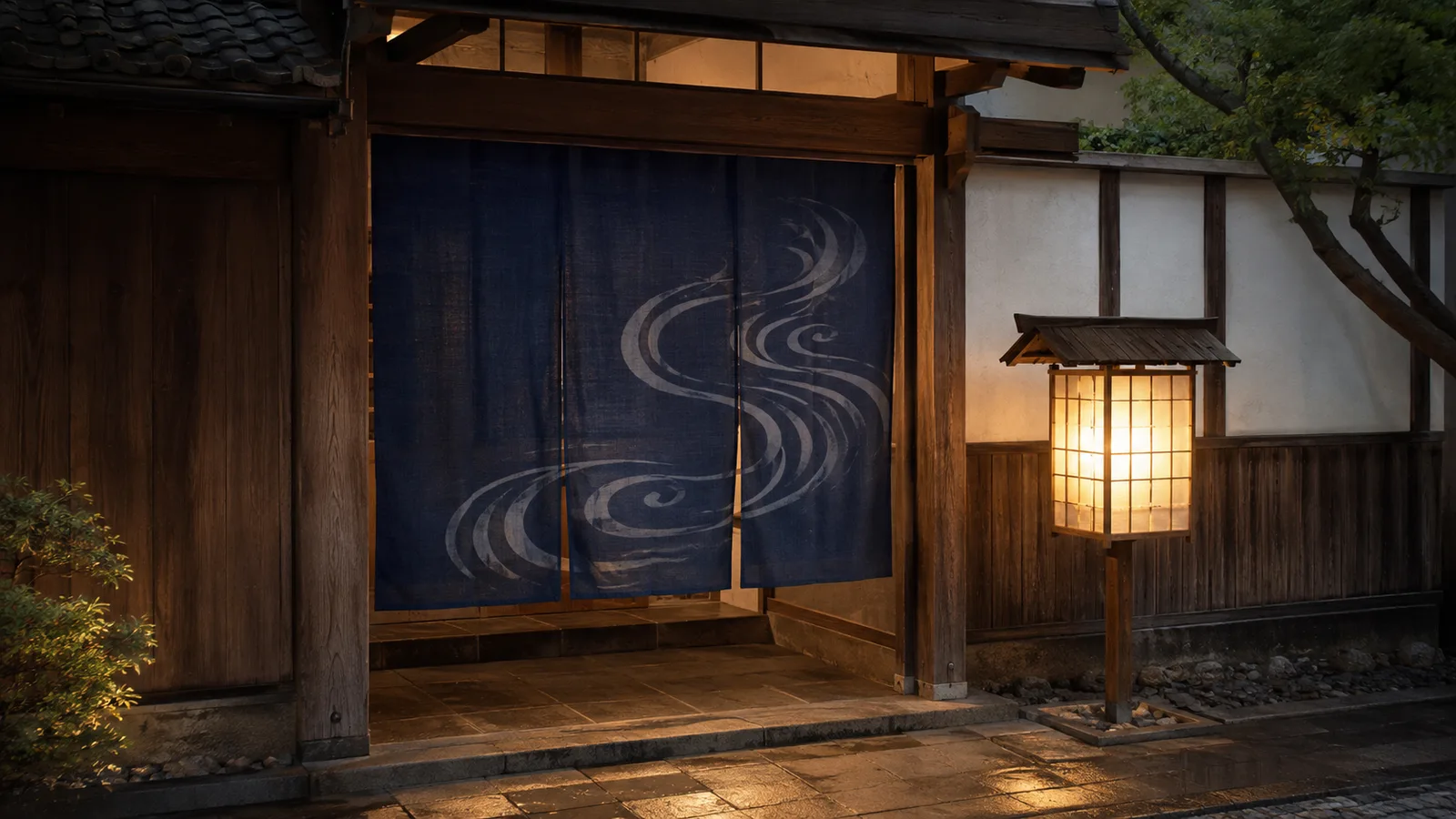
The short answer
A sento is a neighborhood public bathhouse, usually heated with ordinary tap water. An onsen uses natural hot spring water that meets specific legal conditions. A super sento is a larger bathing-and-leisure facility with extras like saunas or outdoor baths. Here’s how the three compare at a glance.
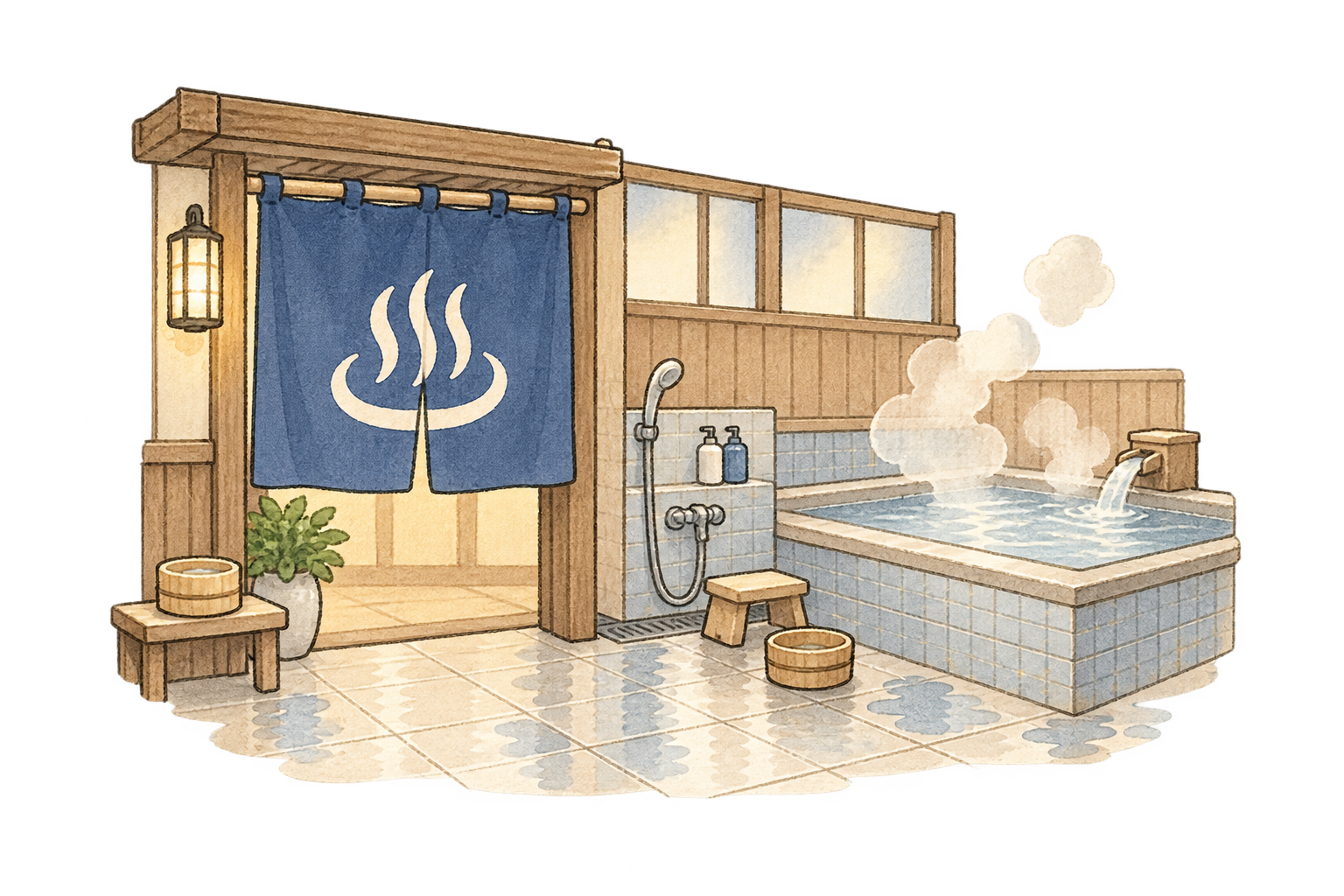
SENTO
A neighborhood public bath, usually using heated tap water.
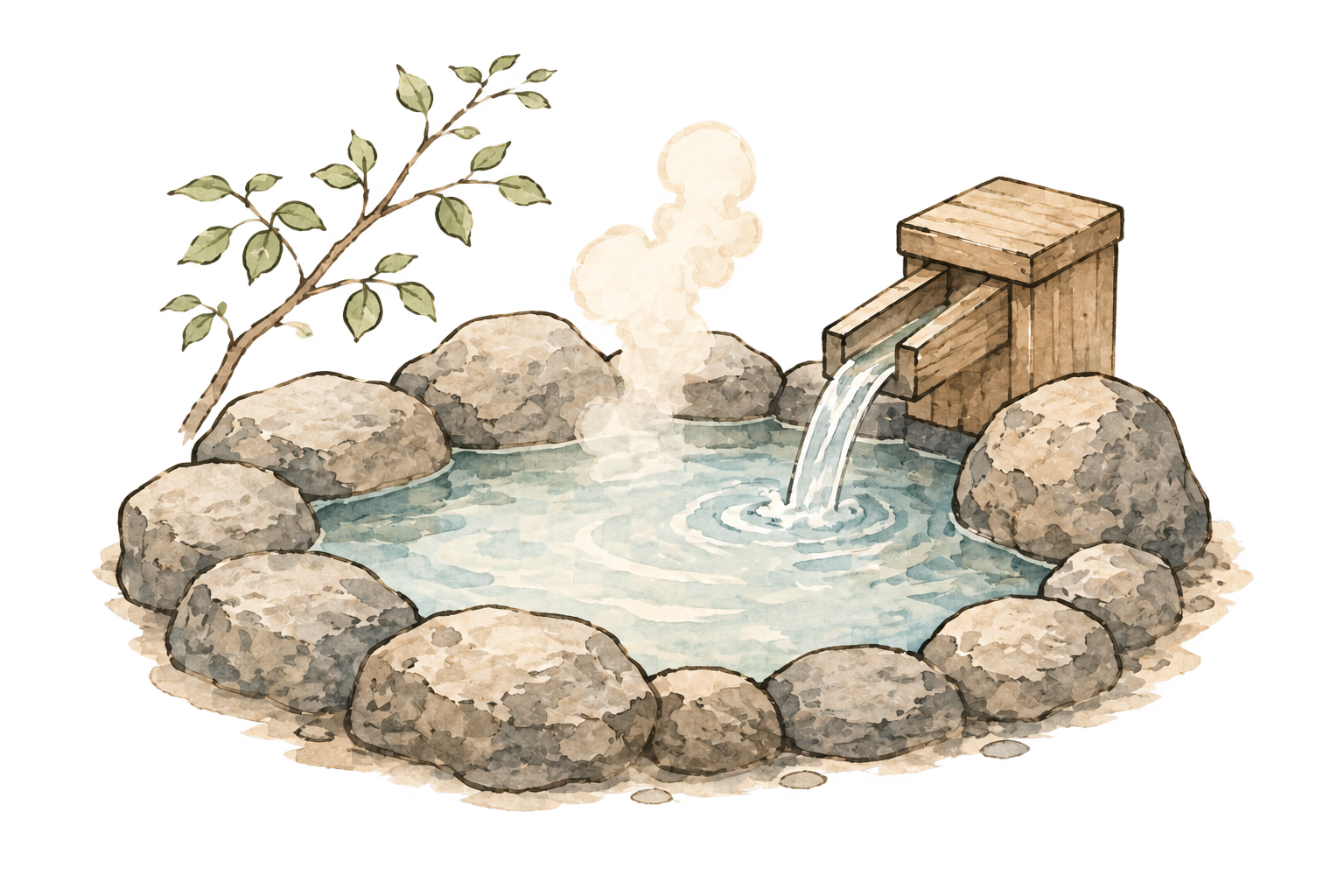
ONSEN
A bath using natural hot-spring water that meets Japan's legal definition.
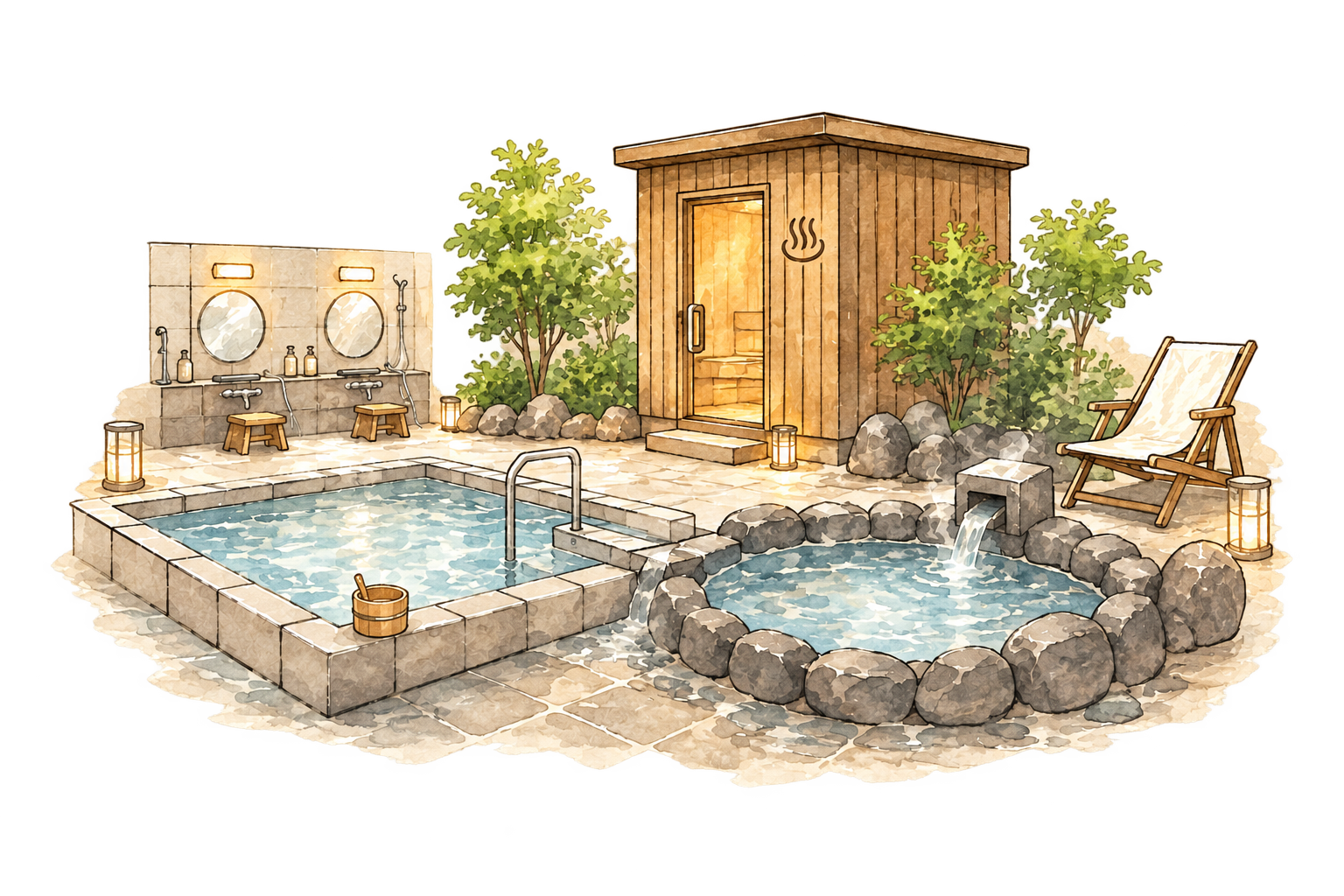
SUPER SENTO
A larger bathing and leisure facility with more ways to relax.
These categories overlap more than the names suggest. A neighborhood sento may use water that legally qualifies as onsen if it meets the mineral or temperature threshold below, and many super sento use real hot-spring water too. When in doubt, a facility’s own website usually says so clearly.
What is a sento?
A sento is a neighborhood public bathhouse, part of Japanese daily life for generations—once a place to bathe for households without a bath of their own, and still a place to unwind and see familiar faces. Most heat ordinary municipal water rather than drawing from a hot spring, though a number of sento genuinely sit above a natural spring.
What is an onsen?
Onsen refers to water meeting the definition in Japan’s Hot Spring Act. To qualify, water rising from underground must either reach at least 25°C at the source, or—regardless of temperature—contain a minimum concentration of specific dissolved substances listed in the law. A cooler spring can still count as onsen on mineral content alone. Onsen water shows up in dedicated hot spring towns, at traditional ryokan inns, in city hotels, and even inside some sento.
What is a super sento?
Super sento are larger, more elaborate facilities—an expanded, leisure-oriented version of the neighborhood sento. “Super sento” describes a facility’s scale, not its water source: many use heated tap water, while others genuinely pipe in natural hot spring water and could rightly be called onsen too. Checking a facility’s own site is the only way to know for certain.
What they have in common
Bathing areas are shared, and everyone bathes without swimwear. Baths are usually separated by gender, though a small number of facilities offer mixed, family, or private options.
Bathing etiquette, step by step
The routine is much the same almost everywhere:
Shoes off
Remove your shoes at the entrance.
Check in
Pay at reception and check the facility's rules.
Undress
Remove all clothing in the changing room.
Wash first
Wash and rinse thoroughly before entering the bath.
Hair up
Keep long hair out of the bathwater.
Towel out
Never put your small towel in the bath.
Soak quietly
Relax in the bath without washing or swimming.
Dry off
Wipe your body before returning to the changing room.
Some bathers also pour warm water over themselves before soaking, a practice known as kakeyu.
What about tattoos?
Tattoo restrictions have historical ties to Japan’s association of tattoos with organized crime, although attitudes are gradually changing. Some facilities offer cover stickers for small tattoos, or a private bath you can book for yourself or your family.
Policies vary. Many neighborhood sento allow tattoos, while many onsen and super sento do not. Always check the facility's official policy before visiting.
Policy really does vary that much from door to door—for a deeper look at how it breaks down and how to check before you go, see our guide to tattoos at a Japanese onsen.
How Japanese bathing is changing
A neighborhood bath serving local daily life.
A larger facility with baths, dining, and relaxation spaces.
New saunas, upgraded facilities, cold baths, and outdoor rest areas.
Japan’s recent sauna boom has added a new dimension to its long-established bathing culture.
Neighborhood sento have been declining for decades. Union-affiliated sento nationwide peaked at 17,999 in 1968 and had fallen to 1,493 by April 2026, according to Japan’s National Federation of Public Bathhouse Associations. Separately, Japan’s Ministry of Health, Labour and Welfare notes that general public baths made up 87% of all licensed bathing facilities in 1970, a share that had dropped to 12.0% by fiscal 2023.
At the same time, larger facilities and a broader sauna boom have reshaped what a bathing visit can look like—bringing sauna upgrades to many super sento, dedicated sauna venues, private sauna rooms, and renovations at some older sento too. A number of long-running neighborhood sento have found new, younger visitors this way.
None of this means every sento is old-fashioned or every super sento is new. Both categories include a wide range of facilities—what’s shifting is the shape of the industry as a whole, not any single type of bath.
A simple sauna routine
If a facility has a sauna, the routine is simple, and there’s no need to overthink it:
SAUNA
Warm up at a comfortable pace.
COOL DOWN
Use a cool shower or cold bath only if it feels comfortable.
REST
Sit down, breathe, and rehydrate.
Which one should you choose?
Choose a sento
Choose a super sento
Choose an onsen
English guidance, tattoo policies, prices, facilities, and opening hours vary by location. Check the official website before visiting.
A gentle first visit
If bathing without clothes among strangers feels unfamiliar, that’s completely normal for a first time. Choose the setting that feels easiest for you: a neighborhood sento for a local experience, a super sento for more amenities, or a private bath for greater privacy. Many facilities welcome first-time visitors. If you are unsure, check the official website or ask at reception.
None of this needs a guide—most people pick the sequence up by following the person ahead of them, and the entry fee at a neighborhood sento is a few hundred yen. But if doing it alone the first time is the part you’d rather skip, a guided hour is one way through: this one is at an open-air bath in central Tokyo near the Skytree, with someone there to answer the questions this page can only anticipate. Worth knowing before you book: the baths are shared and separated by gender rather than private, the women-only side doesn’t include the large open-air bath (the listing says that since February 2024, because of chimney work, the large open-air bath has been men-only and the small open-air and carbonated baths women-only, with no switching by day; checked September 28, 2026), and tattoos are accepted here—which, as the section above notes, is not something to assume anywhere else.
See the guided Tokyo onsen hour on KlookThis page contains affiliate links. If you book through them, AHH, JAPAN may earn a commission at no extra cost to you.
In closing
Sento, onsen, and super sento each offer their own version of the same idea: a shared, unhurried pause in the day. Rules, prices, and amenities vary from place to place, so it’s always worth checking a facility’s official website before you go.
Curious how these customs play out in a real hot-spring town? See our guide to onsen towns in Japan. And if a trip isn’t on the calendar yet, you can still borrow the sequence at home—see bringing the bathing ritual home.
Take it slow. Ahh…
Curious about YUGE, the character guiding you through this site? Meet YUGE—and find a few small ways to bring that calm home—on the YUGE page.
Some editorial images in this article were AI-generated and do not depict specific venues.
Sources
- Japan Hot Spring Act — Japanese Law Translation
- Japan National Tourism Organization — How to Best Enjoy Japan’s Onsen
- Japan National Tourism Organization — Enjoy Bath Culture in Japan
- Tokyo Sento Association — How to Enjoy Sento
- National Federation of Public Bathhouse Associations — Number of Sento Nationwide
- Ministry of Health, Labour and Welfare — Overview of the Public Bathhouse Industry
- Klook — Tattoo-friendly open-air onsen experience in Tokyo (listing conditions)