Once you know the bathing routine, the next question is usually a practical one: what do you carry in, and what do you leave behind? A first onsen visit needs surprisingly little. This guide is a short packing checklist—the two towels people find confusing, a note on hair, a coin for the lockers, and the things most facilities already have waiting for you.
The short answer
For most onsen visits you need a small towel, something to tie back long hair, a coin or two for a locker, and a change of clothes. Almost everything else is either provided or optional. The one idea worth getting straight before you go is that an onsen uses two different towels for two different jobs.
The two towels
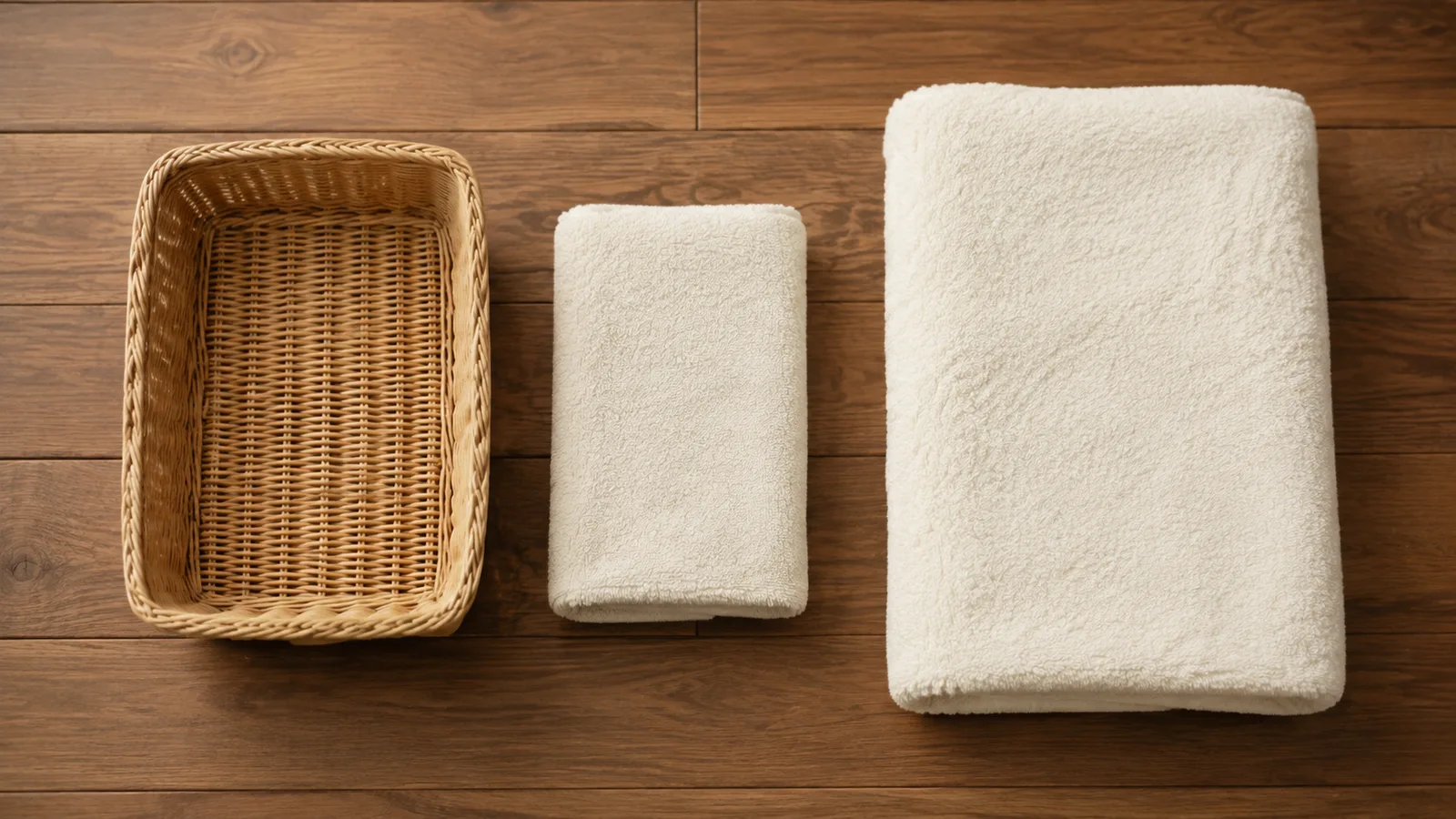
Beppu’s official onsen guide splits them cleanly. The large bath towel is “for drying off completely after your bath,” and you “make sure to keep it in the changing room.” The small towel is “a thin, small towel (like a hand towel or washcloth),” and it “is the only towel you take with you into the bathing area.”
That small towel does a couple of things at once. Japan’s tourism board notes you “may cover yourself with a small towel (usually provided) while you walk to the bath,” and that it “is for washing yourself or covering yourself for modesty before entering the bath—it’s not for use in the bath.” When you get in, you “fold it and place it on your head or on the side of the bath.” A washcloth-sized towel is enough; a hand towel from home works fine.
If you forget one, or want the big towel for after, it’s common for the front desk to rent or sell a towel set for a small fee. A ryokan usually leaves both towels in your room.
For your hair
If your hair is long enough to reach the water, bring a tie or clip for it. Beppu’s guide calls a hair tie “essential” and says hair “must be tied up and kept out of the onsen water.” Japan’s tourism board frames it the same way—“be sure to tie up long hair or wrap it in a towel”—because “onsen water is meant to stay clean and pure.” A plain elastic or a claw clip is all it takes.
A coin, and a bag
Changing rooms usually have lockers or baskets for your clothes and valuables. Japan’s tourism board says “most onsen provide a locker or other secure place to store your valuables, often in the changing room.” Some lockers are free; others are coin-operated, and Beppu’s guide suggests it’s “wise to have a 100-yen coin handy.” Many coin lockers return the coin when you reopen them, but not all do.
A small plastic bag or waterproof pouch is a useful extra. Beppu’s guide recommends one “for carrying your small towel and toiletries” between the changing room and the washing stations.
What you usually don’t need to carry in
Soap and shampoo are often already at the washing stations. Japan’s tourism board describes each spot as having “a bucket, a stool, often a hand-held shower, and amenities.” The catch is that this varies: Beppu’s guide notes that “while many larger onsen provide these, smaller local spots often don’t.” If you’re heading to a small neighborhood bath rather than a resort, a travel-size soap and shampoo are worth tucking in your bag.
For after the bath, Beppu’s guide lists a few optional comforts, including your own skincare and a “hairbrush or comb.” It also suggests carrying some cash—for the entrance fee on the way in, and a vending-machine drink on the way out. A changing room usually has a shared hairdryer; brushes and skincare are things you generally bring yourself.
Amenities differ a lot between a large hot-spring resort and a small neighborhood bath. If you can, check the facility's website before you go, and pack travel-size soap and shampoo when you're not sure.
A note on hydration
A long, hot soak can be dehydrating. Japan’s tourism board’s advice is simple: “take it slow and pop out to get a drink of cool water if you feel too hot.” Many bathhouses have a water fountain or vending machines near the changing room, so you don’t necessarily need to carry a bottle in—just plan to drink something before and after.
If you have tattoos
This is a “check first” item rather than a packing one. Some travelers carry skin-tone cover patches for small tattoos as a backup, but they don’t suit every design and aren’t accepted at every bath. Our guide to tattoos at a Japanese onsen covers how to check a specific place before you travel.
If you’d rather not think about any of this for a first try, a large day-use complex is the easy version: towels and amenities are there, and you can turn up with nothing. This one sits on Tokyo Bay, is open around the clock, and pipes in water from Hakone and Yugawara. One thing to check first, because it isn’t a small detail: tattoos are only admitted if covered with the facility’s cover sheets (max 11cm × 20cm each). Two more rules from its official tattoo page (checked September 28, 2026): tell the front desk about the tattoo when you arrive, because guests who don’t are asked to leave on the spot, and keep the stickers on for your whole time in the building, not just in the bath. Two conditions on this ticket, from Klook’s listing (checked September 28, 2026): guests with tattoos can’t use it, even though the facility itself admits covered tattoos, and it’s valid only for visitors to Japan. If you have a tattoo, skip the ticket and pay at the door instead.
See the Toyosu day-use onsen on KlookThis page contains affiliate links. If you book through them, AHH, JAPAN may earn a commission at no extra cost to you.
A gentle first visit
Packed down to essentials, an onsen trip fits in a small bag: one thin towel, a hair tie, a 100-yen coin, a change of clothes, and travel-size soap if you’re unsure. Everything else is a comfort, not a requirement.
If the routine itself is still new, our beginner’s guide to Japanese baths walks through the washing-and-soaking sequence step by step. For an outdoor bath, what is a rotenburo explains the few things that change when the ceiling comes off. And if you’re planning a trip around several baths, our guide to onsen towns in Japan covers how a hot-spring town is laid out.
Small bag, warm water, nothing to fuss over. Ahh…
Curious about YUGE, the character guiding you through this site? Meet YUGE—and find a few small ways to bring that calm home—on the YUGE page.
Some editorial images in this article were AI-generated and do not depict specific venues.
Sources
- Japan National Tourism Organization — How to Best Enjoy Japan’s Onsen
- Japan National Tourism Organization — A Beginner’s Guide to Onsen
- Beppu City Tourism (Enjoy Onsen) — What to Bring to an Onsen
- Klook — Toyosu Manyo Club ticket listing (conditions)
- Tokyo Toyosu Manyo Club — Tattoo policy (Japanese)